
 Aug 1 2026
 medical image analysis
Human-in-the-Loop Annotation for Healthcare AI: Why It Still Needs a Human
Annotation for healthcare AI is not the same task as labeling everyday photos. A bounding box around a cat is either right or wrong. A bounding box around a subtle finding on a chest X-ray depends on clinical judgment, training, and context that no labeling guideline fully captures on its own.
That gap is exactly why human-in-the-loop annotation exists. It keeps a trained person inside the labeling workflow, not just at the start or end of it, so the resulting dataset holds up during validation, audits, and real-world clinical deployment.
This guide breaks down what human-in-the-loop annotation for healthcare AI actually involves, why fully automated labeling still falls short, and what a reliable workflow looks like in practice.
What Is Human-in-the-Loop Annotation for Healthcare AI?
Human-in-the-loop annotation for healthcare AI is a workflow where a person actively reviews, corrects, or approves labels at defined checkpoints, instead of accepting raw model or annotator output automatically.
In practice, this usually means three things happen together:
- A model or annotator produces a first-pass label.
- A qualified reviewer, often a radiologist or clinical specialist, checks that label against real diagnostic judgment.
- Disagreements get reconciled and fed back into the labeling standard, so the same mistake does not repeat across the next thousand images.
This is different from “human-reviewed” marketing language that only means someone glanced at a sample. True human-in-the-loop annotation reviews systematically, not occasionally.

Why Annotation for Healthcare AI Needs a Human in the Loop
Subtle Findings Are Judgment Calls, Not Just Shapes
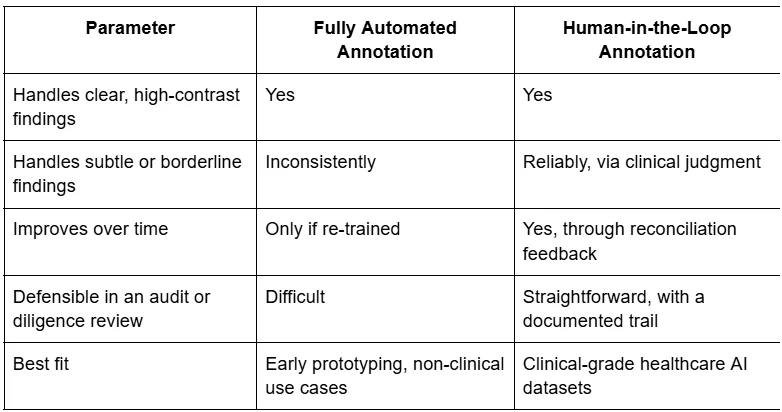
Many findings on an X-ray sit right at the edge of visibility. A general annotator can follow a guideline. A radiologist recognizes when a finding looks unusual enough to flag, even if it does not perfectly match the written spec. That judgment is hard to encode in rules, which is exactly why annotation for healthcare AI benefits from a clinician in the loop.
Fully Automated Labeling Repeats Its Own Mistakes
An automated labeling pipeline applies the same logic to image one and image ten thousand. If that logic misses a certain finding pattern, it misses it consistently, at scale, without anyone noticing until validation. A human checkpoint interrupts that pattern before it compounds.

Regulators and Auditors Expect a Defensible Process
Increasingly, regulators, investors, and enterprise buyers ask how training data was built, not just how a model performs. “A radiologist reviewed and approved every batch” is a defensible answer. “Our pipeline generated the labels automatically” invites more questions than it answers.
Model Accuracy Has a Ceiling Set by the Data
No architecture change fixes a dataset with inconsistent ground truth. Teams that skip human review often trace performance issues back to the same root cause months later: label quality, not model quality.
How Human-in-the-Loop Annotation Works, Step by Step
A reliable human-in-the-loop workflow for healthcare AI annotation typically follows four stages:
- Spec Development – Radiologists and ML teams jointly define what counts as each label, including edge cases, before annotation starts.
- First-Pass Annotation – Trained annotators apply the spec to each image or scan.
- Clinical Review – A radiologist or specialist checks every batch against the spec, flagging disagreements rather than sampling occasionally.
- Reconciliation and Feedback – Disagreements get resolved, and the spec itself gets refined if a recurring edge case reveals a gap.
That feedback loop is what separates human-in-the-loop annotation from a one-time quality check. The process gets sharper as the project scales, instead of drifting.
Human-in-the-Loop vs. Fully Automated Annotation
Benefits of Human-in-the-Loop Annotation for Healthcare AI Teams
- Higher inter-annotator agreement, because disagreements get caught and corrected instead of accumulating silently.
- Fewer re-review cycles later in the project, since issues surface during annotation instead of during validation.
- A defensible audit trail for regulators, investors, or enterprise buyers who ask how the ground truth was built.
- A dataset that keeps improving, since reconciliation feedback refines the labeling spec as edge cases appear.
- Engineering time is protected for modeling, since the data team absorbs the labeling and review burden.
Common Challenges (and How Teams Solve Them)
Challenge: Human review feels like it slows down annotation. In practice, a well-structured review step is faster than the alternative: catching the same error after a failed validation cycle costs far more time than catching it during annotation.
Challenge: Finding radiologists with time for annotation work. Most healthcare AI teams do not have spare radiologist hours internally. This is usually solved by partnering with a specialist annotation provider that already has clinical reviewers built into its workflow, rather than trying to staff this in-house from scratch.
Challenge: Keeping reviews consistent across a large team. Consistency depends on a documented, versioned labeling spec, plus a reconciliation process that feeds disagreements back into that spec, not just into one image at a time.
FAQs
What does human-in-the-loop mean in medical image annotation?
It means a clinician or trained specialist reviews AI-assisted or annotator-generated labels before they are finalized, rather than accepting the output automatically. It’s a core requirement for reliable annotation for healthcare AI.
Is human-in-the-loop annotation slower than automated annotation?
It can add time upfront, but it typically saves time overall by catching labeling errors before they reach model validation, where they are far more expensive to fix.e.
How does human-in-the-loop annotation affect model accuracy?
It improves it indirectly by reducing label inconsistency. Since model accuracy has a ceiling set by ground truth quality, more reliable labels typically translate into more reliable model performance.
Our Thoughts
Annotation for healthcare AI is only as strong as the judgment behind it. Automated labeling can move quickly, but it cannot make the clinical calls that separate a usable dataset from one that fails validation months later. Human-in-the-loop annotation keeps that judgment inside the process, at scale, with a trail your team can defend.
If your team is scoping a human-in-the-loop annotation workflow for an AI project, we’re happy to walk through what that could look like for your specific dataset.