 Feb 13 2025
 AI-Powered Health Data Collection
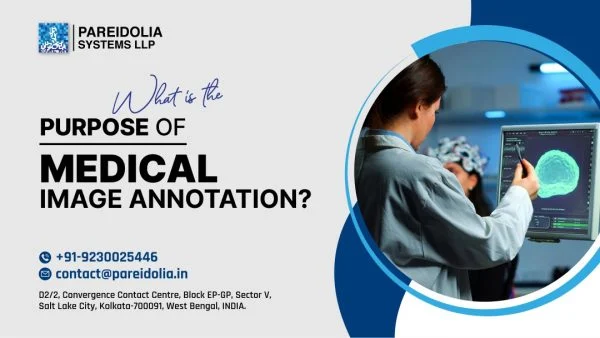
What is the purpose of medical image annotation?
AI Technology & Its Irrigation is one of the most popular in the fast-evolving medical world today. Introduction Among these advancements, medical image annotation is one of the most important processes in healthcare.
It revolutionized the way modern professionals analyze medical data and opened ways for artificial intelligence (AI) to play a role in healthcare systems. By analyzing medical data, Doctors better understand patients’ Current Conditions.
But what is medical image annotation, and why is it important? To understand the necessity and importance of this, you must finish this article.
What Is Medical Image Annotation?
Medical image annotation refers to the process of labeling a medical image to identify regions, objects, or conditions present therein. This may involve staining tumors, lesions, organs, blood vessels, or other anatomical structures. These datasets of labeled images are then used to train AI models, enabling them to identify abnormalities, predict outcomes, or assist radiologists in diagnoses.
In summary, image annotation in healthcare domains serves a critical role in simplifying the interpretation of raw imaging data into meaningful insights. Machines are not able to interpret or learn from medical images without annotated datasets.
What is the Main Purpose of Medical Image Annotation?
Medical image annotation primarily translates unstructured visual data into structured data. This process enables AI systems to “interpret” medical images and assists physicians in:
- Early Diagnosis: Annotated datasets enable AI systems to identify diseases at earlier stages, leading to better patient outcomes.
- Precision Treatment: Annotated images make certain that treatments are targeted and accurate by identifying certain areas or abnormalities.
- Streamlined Workflow: Annotated data lights the workload off TLPs and TPPs, allowing them quick decision-making.
- Advancing Research: It drives AI-based innovations in medical research.
As you see The Importance of Medical Image Annotation in Healthcare Sector is so important that The Right way & High Quality Tools is Very Important.
Medical Image Data Preparation
Medical Image Data preparation is the Step Doctor’s take before annotation. This means finding the right datasets, making sure they work together, and satisfying specific criteria.
Dataset Type
Medical imaging includes diverse types of modalities from X-rays, CT scans, MRI, Ultrasound, and histopathology slides. Annotation techniques for the datasets vary depending on the study’s purpose.
That includes a diversity of data in medical imaging, for example:
X-rays: Commonly used to visualize fractures, infections, or lung pathology.
CT Scans: Best for detailed cross-sectional views of internal organs.
MRIs: Used to view soft tissue such as the brain and joint imaging.
Ultrasounds: Commonly used as a fetal health monitor and for diagnosing cysts or excessive fluid build-up.
Genomic Data: Genetic information used for cancer detection and research.
It needs different types of annotation techniques that are specific to the purpose of the Study.
Dataset Size
Large Dataset size, AI models reliability Big datasets covering a wide variety of examples of Medical Image labeling ensure algorithms have a more positive learning experience. However, it is often hard to get significant data for medical images since there are privacy problems and accessibility.
Dataset Format
The various formats for imaging data are mainly DICOM, TIFF, and PNG. These formats need to be standardized for easy integration into annotation tools and AI systems.
Medical imaging data is available in different formats:
DICOM: A format standard for medical imaging storage.
TIFF: A common format for high-res pathology images.
PNG/JPG: Simplified formats used in general research or AI testing.
Standardizing these formats also makes them easy to integrate into annotation tools and AI systems.
Medical Image Annotation vs. Regular Data Annotation
Although data annotation is common to all industries, medical image annotation stands out due to the complexity and sensitivity of healthcare data. Here’s how it differs:
Data Availability
Data in other fields often comes easier — healthcare data is generally protected under strict privacy laws. Annotation teams have to strike a balance here to the above-mentioned limitations while ensuring data quality.
Technical Differences
Medical imaging contains convoluted data such as 3D scans and multi-dimensional imaging. Medical annotation is more complex than typical image annotation due to the need to comprehend medical imaging modalities and clinical needs.
HIPAA, FDA, and CE Compliance
When operating with medical data, you have to comply with a lot of regulations, such as HIPAA (Health Insurance Portability and Accountability Act), FDA (Food and Drug Administration), CE (Conformité Européenne), etc. Such regulations link to the safety, privacy, and ethical use of the annotated datasets.
Medical Imaging Contains Transparencies
Medical Image annotations are not just a single two-dimensional image, as is common with regular images, but instead contain multiple layers or “slices” that each require detailed labeling. These transparencies complicate and increase the difficulty of the labeling of medical images.
Types of Medical Data Image Annotation
Medical annotation comes in various forms, each catering to specific needs:
- Semantic Segmentation: Segment the image into separate parts and assign a label (for example, organ, tumor) to each pixel.
- Bounding Boxes: It draws rectangular boxes around objects of interest, such as lesions or fractures.
- Polygonal Segmentation: Use shape-specific annotations for irregular structures.
- Landmark Annotation: It marks specific points on the image, often useful for facial or skeletal analysis.
- 3D Annotation: Annotating multi-dimensional data from scans such as CT or MRI
Biggest Challenges in Medical Data Annotation
Despite its importance, annotating medical data comes with unique challenges:
Privacy
The most important thing we do is protect patient confidentiality. Annotators also need to comply with strict data protection legislation and usually sign up with their work to anonymized datasets.
Expertise
Domain knowledge is required for medical annotation. It is resource-intensive, as the annotation process may require radiologists, pathologists, or trained professionals to lead the annotation process.
Formats
Medical data comes in many formats, especially audio, video, or images that are high-resolution, multi-layered, or 3D, which require special tools.
Choosing the Right Annotation Tools for Medical Images
It is a well-known fact that the tool makes a difference in medical image annotation. Here are some factors to consider when choosing an annotation tool:
- Compatibility: Make sure the tool can work with the data formats and types that you are using.
- Functionality: Choose features such as multi-dimensional annotation, AI-assisted labeling, and team collaboration.
- Scalability: Find a tool that can work with large datasets as your needs expand.
- Security: Ensure the tool meets healthcare compliance standards safeguarding sensitive information.
Top 5 Questions to Ask Before Outsourcing Healthcare Data Labeling
It prevents the wastage of time energy, and money. But before settling on a partner, ask these vital questions:
- Healthcare data annotation experience?
- Can they offer a trained workforce with medical expertise?
- What kind of security infrastructure do they use?
- Can their tools work with medical imaging formats that are synthetic or specialized?
- What measures do then possess to comply with regulations such as HIPAA as well as GDPR?
What Sets Pareidolia Apart?
Despite being a leader in data annotation for medical imaging, Pareidolia also prides itself on the quality and efficiency of the work it delivers. What makes Pareidolia special is this:
Fully-managed Teams with Experts
The teams of Pareidolia include experts at different levels, so the highest standards are applied to each annotation.
Tech & Tool Combined Approach for Maximum Productivity
Their flexible approach enables them to use the most productive and adaptable tool or technology.
Rapid Scalability
And whether you require annotations for a pilot project or a full-scale study, Pareidolia’s resources can scale to your needs.
Robust Security
Pareidolia provides world-class security measures to keep sensitive medical information confidential.
Working with Global Companies
Pareidolia partners with leading healthcare organizations across the globe, establishing its credibility and trustworthiness.
What Does the Future of Medical Annotation Look Like?
Machine Learning Innovations in the Future of Medical Image Annotation It is anticipated that automated systems, driven by annotated datasets, will:
- Learn to detect diagnostics with less human effort.
- Provide real-time, accurate analysis.
- Support customized therapies.
- So step that medical research up exponentially.
In AI’s development, the need for quality annotated medical images will be increasingly important.
Let’s Work Together to Build Smarter AI
No matter who you are in this industry, your profession is impacted by AI in healthcare. So by working together on medical image annotation projects, we can enhance innovation and improve health outcomes globally.
Services
In essence, Pareidolia provides a variety of services ranging from manual or automated annotation, dataset volume preparations, and compliance consulting.
Resources
Learn more about annotation techniques in medical imaging and their role in AI development by browsing through the extensive resources offered here at Pareidolia.
Company
Now you might Understand The Role of Annotation in Medical Image Analysis. So Team up with Pareidolia to unleash the power of AI in medicine, backed by expertise, technology, and a commitment to quality.
Conclusion
Enhancing AI with Medical Image Annotation makes the best Combo In the healthcare Sector. By Using These Technologies Medical Treatment become more efficient.
Such projects will spur innovation for the better and improve medical outcomes across the globe. The healthcare sector is in pursuit of a future that is both more efficient and accurate, all centered around the patient through the amalgamation of human expertise and artificial intelligence accuracy.