 May 1 2025
 Medical Image Annotation
What are the Challenges in MEDICAL IMAGING in Clinical Research?
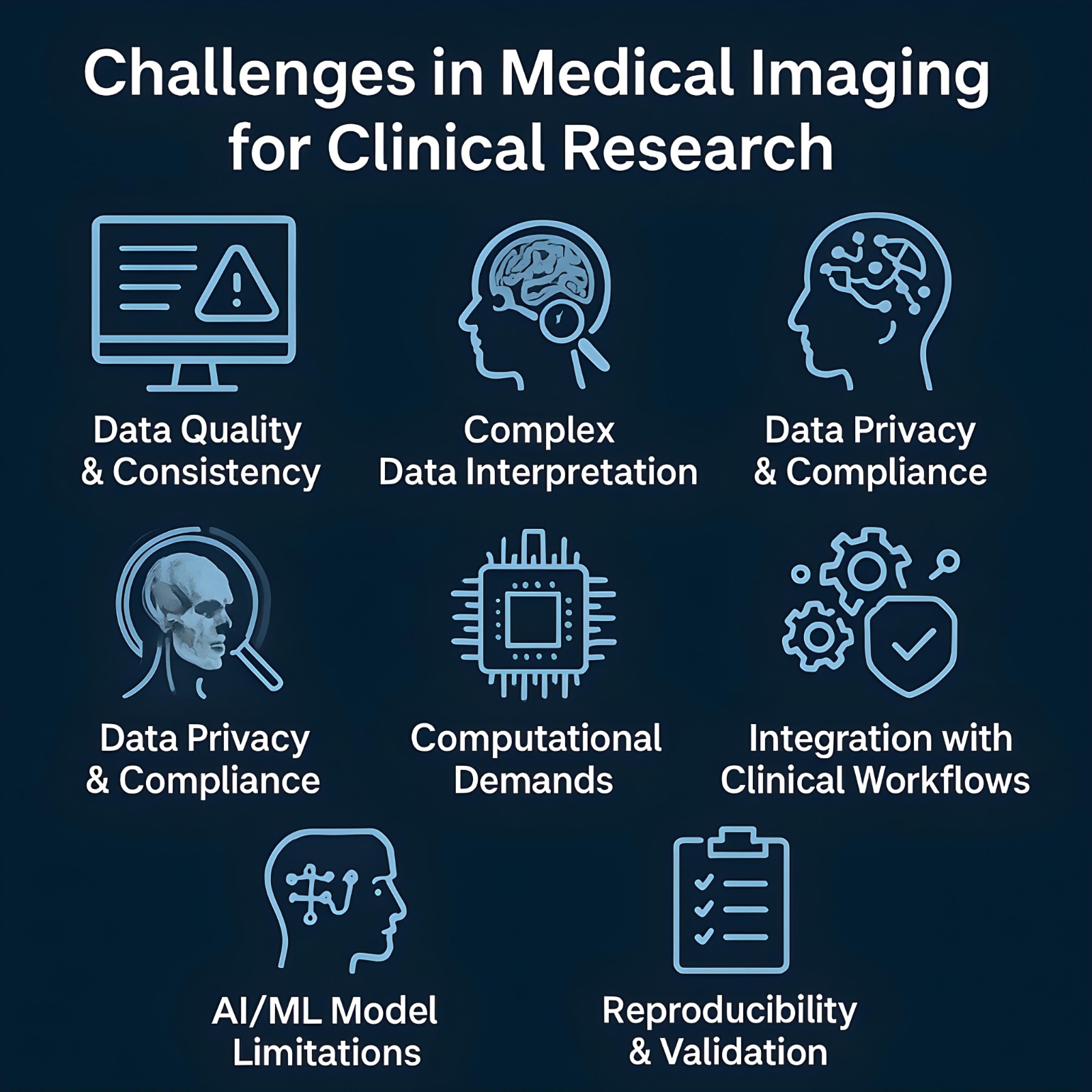
Medical imaging is pivotal in clinical research, helping researchers gain critical insights into disease mechanisms, progression, and treatment response. However, as indispensable as imaging is, it comes with its own set of complex challenges. From data quality and consistency to limitations in AI/ML models, the hurdles are multifaceted and demand innovative solutions. At Pareidolia, we leverage cutting-edge technologies and advanced processes to tackle the intricacies of medical imaging with precision and innovation.
As clinical trials grow increasingly complex and data-driven, the role of medical imaging becomes even more prominent. However, despite its numerous advantages, significant challenges still hinder its optimal use in clinical research.
This article, presented by Pareidolia, explores the major challenges faced in medical imaging for clinical research and highlights the technological advancements and strategies needed to overcome these barriers.
-
Data Quality & Consistency
Data quality is the backbone of any clinical research study. In medical imaging, this translates to consistent image acquisition, high-resolution data, and standardized imaging protocols. Variability in imaging equipment, technician skill level, and patient movement can significantly affect image quality. Moreover, inconsistencies across different clinical sites often lead to data heterogeneity, making it challenging to draw reliable conclusions.
Key issues include:
- Non-uniform imaging protocols.
- Inconsistent contrast and resolution.
- Variability in patient positioning.
To address these issues, Pareidolia employs standardized imaging protocols, rigorous quality checks, and cross-site harmonization techniques. These practices help ensure that the data collected is reliable and consistent across all research environments.
-
Limited Annotated Data
Annotated datasets are crucial for training and validating machine learning algorithms in medical imaging. However, creating high-quality annotations requires expert radiologists, which is both time-consuming and costly. Additionally, privacy concerns often limit access to sufficiently large datasets.
Challenges include:
- Scarcity of expert-annotated images.
- High costs are associated with manual annotation.
- Legal and ethical barriers to data sharing.
Pareidolia addresses this challenge by leveraging semi-supervised learning and active learning approaches that require fewer labeled examples. We also collaborate with healthcare providers to build de-identified datasets that adhere to strict privacy standards.

-
Complex Data Interpretation
Medical imaging data is inherently complex, often requiring multi-dimensional analysis and advanced visualization techniques. Understanding subtle changes in imaging biomarkers across time or treatment requires both domain expertise and sophisticated analytical tools.
Issues faced include:
- High-dimensional image data
- Temporal variability in longitudinal studies
- Subtle imaging biomarkers that are hard to quantify
Pareidolia utilizes state-of-the-art visualization tools and AI-powered analytics to assist clinicians and researchers in interpreting complex imaging data effectively. Our platforms are designed to provide intuitive insights, thereby reducing cognitive load and enhancing diagnostic accuracy.
-
Data Privacy & Compliance
Given the sensitive nature of medical imaging data, maintaining data privacy and adhering to compliance standards such as HIPAA and GDPR is non-negotiable. Breaches can have severe legal and ethical ramifications.
Major concerns include:
- Ensuring data anonymization
- Secure data storage and transfer
- Meeting international compliance standards
At Pareidolia, we prioritize data security with robust encryption protocols, access control mechanisms, and regular audits. Our solutions are fully compliant with global data protection regulations, ensuring that sensitive patient information remains secure.
-
AI/ML Model Limitations
Artificial Intelligence and Machine Learning are transforming medical imaging, but they are not without limitations. Models often suffer from bias, lack generalizability, and require extensive validation.
Key limitations include:
- Overfitting to specific datasets
- Poor generalization across demographics
- Lack of explainability in model predictions
To mitigate these challenges, Pareidolia emphasizes model transparency, rigorous cross-validation, and the inclusion of diverse datasets during model training. Our AI solutions are built to be interpretable and trustworthy, empowering clinicians to make informed decisions.
Top Challenges in Medical Imaging in Clinical Research
Medical imaging plays a crucial role in advancing clinical research by providing detailed, non-invasive insights into the human body. It aids in everything from early disease detection to monitoring treatment progress. However, while the potential of medical imaging in clinical research is vast, there are several challenges that researchers and clinicians face when utilizing these technologies. Below, we discuss in greater detail the most significant challenges in medical imaging for clinical research.
01. Lack of Standardization Across Imaging Modalities
One of the most significant hurdles in clinical research involving medical imaging is the lack of standardization across different imaging modalities. Medical imaging encompasses a wide range of technologies, including MRI, CT scans, X-rays, ultrasound, and more. Each of these technologies has its own set of protocols, calibration methods, and software settings.
- Impact on Data Consistency: The absence of standardized protocols results in data variability, making it difficult to compare images across different research sites or even within the same institution over time.
- Multi-Center Trials: In clinical research, multi-center trials are common, and without consistent imaging standards, it becomes challenging to ensure uniformity in the results, which is crucial for the study’s reliability and validity.
To address this issue, efforts to create unified imaging guidelines are ongoing, but significant progress is still needed to ensure that imaging data is consistent across different platforms and research centers.
02. Data Integration and Interoperability Issues
Medical imaging generates a vast amount of data, but this data often exists in silos, disconnected from other critical patient information, such as electronic health records (EHR) and genomic data. Integrating medical imaging data with other clinical data sources is essential for comprehensive research, but is hindered by several factors:
- Incompatible Data Formats: Different imaging technologies produce data in proprietary formats, and not all imaging systems can easily exchange data with hospital information systems.
- Interoperability Barriers: The lack of interoperability between various healthcare systems further complicates the integration process. Researchers often struggle to merge imaging data with other health data, which limits their ability to analyze and interpret findings comprehensively.
Overcoming these barriers requires the adoption of interoperable standards such as DICOM (Digital Imaging and Communications in Medicine) and HL7, which can facilitate seamless data exchange between different systems and institutions.
03. High Costs and Limited Resources
The cost of advanced medical imaging equipment, such as MRI, PET scans, and CT scanners, is extraordinarily high. In addition to the purchase price of these machines, there are ongoing costs associated with maintenance, operation, and skilled personnel. This financial burden limits the accessibility of medical imaging in clinical research, particularly in resource-limited settings.
- Equipment and Facility Costs: Specialized imaging equipment is expensive, and many research centers, especially those in developing countries or smaller institutions, struggle to afford it.
- Skilled Personnel: Operating sophisticated imaging devices requires highly trained technicians and radiologists. The training and salaries of these professionals add to the cost, further limiting access to high-quality imaging in clinical research.
To make medical imaging more accessible, researchers are exploring more affordable alternatives, such as portable imaging devices and artificial intelligence (AI)-powered diagnostic tools, but cost remains a significant challenge.
04. Massive Data Volume and Storage Requirements
Medical imaging produces enormous volumes of data, particularly with high-resolution scans or 3D imaging. Managing and storing this data is a monumental task, as it requires a vast storage infrastructure.
- Data Storage: High-resolution images and 3D datasets consume substantial storage space, and research institutions must invest in secure, scalable data storage solutions.
- Data Management: With the large volume of data generated, managing, organizing, and backing up these datasets is complex. Ensuring that data remains accessible for analysis without risking loss or corruption is a key challenge.
Cloud computing and distributed storage solutions have provided some relief, but ensuring the security and integrity of these data stores remains a critical concern.
05. Variability in Image Analysis and Interpretation
While medical imaging offers non-invasive insights into the body, the interpretation of these images is highly subjective. Radiologists or researchers may interpret the same images differently based on their experience, knowledge, and expertise.
- Human Error: Even experienced professionals may miss subtle details or make incorrect judgments, leading to misdiagnosis or missed diagnoses. Image interpretation is particularly prone to human error in complex cases where subtle anomalies exist.
- Artificial Intelligence (AI): While AI has shown promise in automating and enhancing image analysis, it still faces challenges in providing consistent results. AI algorithms are trained on large datasets, but these datasets may be biased or incomplete, leading to inaccurate or inconsistent interpretations.
Efforts are underway to improve AI models for image analysis, and standardized training protocols for radiologists can help reduce variability in interpretation. However, human expertise is likely to remain crucial for the foreseeable future.
06. Regulatory and Compliance Challenges
Medical imaging used in clinical research must adhere to strict regulatory standards, including ethical approvals, privacy laws, and medical device regulations. The complexity of navigating these regulatory requirements often causes delays and increases administrative burdens.
- Ethical and Privacy Concerns: Researchers must ensure that all patient data, including imaging data, is de-identified to protect patient privacy. However, in some cases, particularly with advanced imaging techniques like brain scans, anonymizing data is difficult without losing crucial research information.
- Approval Processes: Clinical research involving new imaging technologies or biomarkers must go through lengthy approval processes before it can be conducted. The approval process often includes validating imaging biomarkers, which is time-consuming and requires substantial resources.
Adhering to regulatory standards is crucial for protecting patient rights, but it also limits the speed at which new imaging techniques can be adopted in clinical research.
07. Patient Privacy and Ethical Concerns
Medical imaging often involves capturing highly detailed images of patients, sometimes including sensitive areas like the brain or face. This raises significant ethical concerns, especially related to patient privacy and the use of personal health data in research.
- Incidental Findings: Medical imaging can uncover unexpected findings unrelated to the research objective. These incidental findings, such as tumors or other abnormalities, may not be part of the research focus, raising ethical dilemmas about whether to inform the patient about such findings and how to handle them.
- Data De-Identification: De-identifying imaging data to protect patient privacy is challenging, particularly when the data could potentially be linked to identifiable individuals through advanced algorithms.
Ensuring that patient privacy is maintained without compromising the quality of research data is a complex balance that clinical researchers must navigate.
08. Limited Access to Imaging Infrastructure
Not all research sites have access to high-end imaging technologies, particularly those in rural or underserved areas. This lack of access to imaging equipment can limit the diversity of study populations and may introduce bias in clinical research outcomes.
- Geographic Disparities: Research conducted in areas without access to advanced imaging equipment may result in an underrepresentation of certain demographics, potentially skewing the research findings.
- Equity in Research: Ensuring that clinical research reflects a diverse patient population is essential for developing treatments that work for everyone. Limited access to imaging infrastructure hampers this goal.
Efforts to make imaging technology more accessible, such as the development of portable devices and telemedicine solutions, may help alleviate some of these challenges.
09. Technical Limitations in Image Quality
Despite the sophistication of modern imaging technologies, technical limitations still affect the quality of images. For example, motion artifacts, poor contrast, and low resolution can compromise the clarity of the images, leading to incomplete or inaccurate data.
- Motion Artifacts: In imaging techniques such as MRI and CT scans, patient movement can create artifacts that distort the images, making them harder to interpret.
- Low Contrast and Resolution: Some imaging methods, particularly ultrasound, may not provide sufficient resolution or contrast to detect subtle changes in tissues, limiting their effectiveness in clinical research.
Improving the technical capabilities of imaging devices and training patients to minimize movement during scans can help mitigate these issues.
10. Slow Validation of Imaging Biomarkers
Imaging biomarkers, which provide measurable insights into the biological processes of diseases, are essential for many clinical studies. However, the validation process for these biomarkers is often slow and requires extensive clinical trials.
- Lengthy Validation Process: Validating an imaging biomarker involves proving its reliability and reproducibility across different patient populations and settings. This process can take years and requires large-scale studies.
- Regulatory Hurdles: Before imaging biomarkers can be widely adopted, they must pass through a rigorous regulatory approval process, which can delay their application in clinical research.
Despite these challenges, the development of validated imaging biomarkers has the potential to significantly advance personalized medicine and precision health.

11. Ethical Considerations in Imaging Research
Ethical issues in medical imaging research are multifaceted. Beyond patient privacy, questions arise regarding informed consent, incidental findings, and the communication of imaging results to participants.
For instance, a clinical trial participant undergoing an MRI may have an unrelated abnormality detected. Determining whether and how to report such findings requires ethical judgment and clear protocols. These challenges necessitate robust ethical frameworks and training for researchers and clinicians.
12. Artificial Intelligence Integration Challenges
AI and machine learning are poised to transform medical imaging in clinical research by enhancing image analysis, detecting patterns, and improving diagnostic accuracy. However, integrating these technologies into research settings poses unique challenges.
Key concerns include data bias, algorithm transparency, reproducibility, and clinical validation. Furthermore, AI systems must comply with evolving regulatory guidelines, which adds a layer of complexity to their adoption in clinical research environments.
The Future of Medical Imaging is AI-Powered Human + AI Collaboration
For professionals in AI, machine learning, and computer vision, tackling the challenges in medical imaging isn’t just a technical task—it’s a mission to improve lives. As the demand for accurate, efficient, and interpretable medical imaging solutions grows, the need for skilled innovators becomes more critical than ever.
The challenges in medical imaging aren’t just technical—they’re multidisciplinary, requiring collaboration between engineers, clinicians, and researchers. By addressing these core issues, professionals can develop solutions that truly enhance clinical outcomes.
At Pareidolia, we help bridge these gaps by creating AI-powered imaging tools that are accurate, interpretable, and ready for clinical impact. Whether you’re an AI Researcher, ML Engineer, or Computer Vision Scientist, now is the time to lead the change in medical imaging innovation.
How Pareidolia is Solving These Challenges
At Pareidolia, we bridge the gap between AI innovation and clinical reality. Our research-driven team works hand-in-hand with clinicians to:
- Leverage AI models trained on medical imaging datasets to ensure precise annotation and segmentation aligned with clinical standards.
- Collaborate with certified radiologists and clinical experts to validate annotations, ensuring accuracy and regulatory compliance.
- Develop and implement standardized annotation & segmentation guidelines to maintain consistency across datasets and studies, minimizing variability.
- Use secure platforms that follow HIPAA and GDPR protocols to protect sensitive patient data during annotation and segmentation processes.
- Employ multi-level QA, including peer reviews and automated error detection, to maintain high annotation & segmentation accuracy and reproducibility.
- Utilize hybrid workflows combining AI-driven pre-annotation with expert review to accelerate throughput without compromising precision.
- Use cloud-based platforms to allow geographically distributed teams to collaborate efficiently and access annotations in real time.
- Ensure annotated data is well-documented and formatted to meet FDA, EMA, or other regulatory body submission requirements.
- Streamline operations through agile project management and dedicated annotation teams to meet tight clinical trial timelines.
- Optimize models for high performance, even with limited resources.
We’re committed to transforming medical imaging in clinical research with solutions that are intelligent, compliant, and clinically valuable.
Medical imaging in clinical research offers unparalleled opportunities for innovation and discovery. However, the journey is fraught with challenges ranging from data quality to ethical considerations. At Pareidolia, we are committed to overcoming these barriers through advanced technology, expert collaboration, and a steadfast focus on quality and compliance. As medical imaging continues to evolve, addressing these challenges will be key to unlocking its full potential in transforming healthcare.
Pareidolia Systems LLP is a technology-driven company specializing in advanced medical imaging solutions for clinical research. Our mission is to simplify complex imaging workflows while ensuring data integrity, privacy, and actionable insights. Through innovation and collaboration, we are redefining the future of medical imaging in clinical research.