 May 27 2026
 AI Deployment
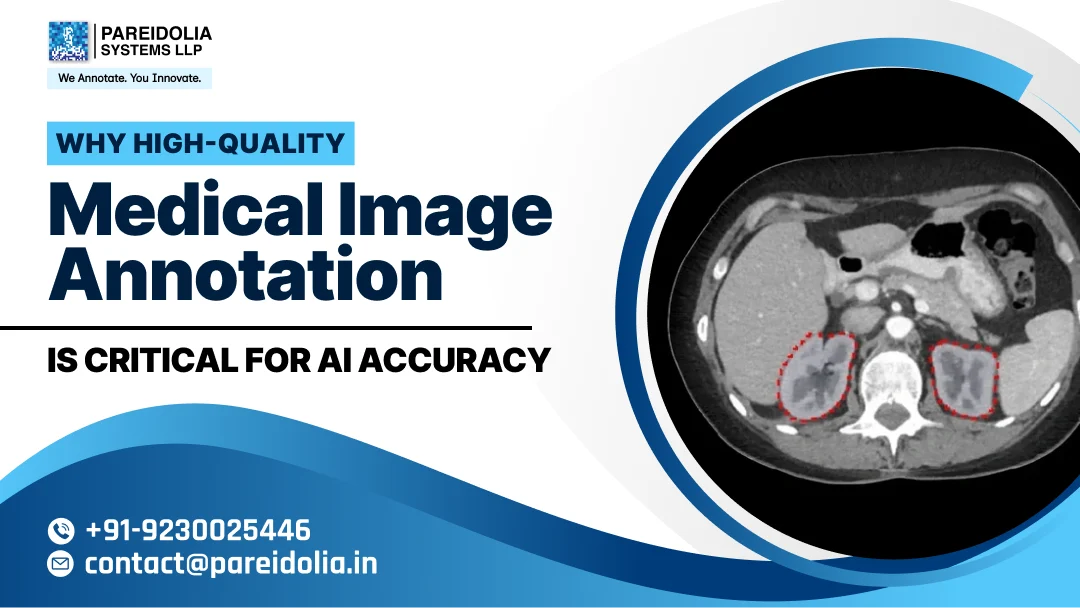
Why High-Quality Medical Image Annotation Is Critical for AI Accuracy
At Pareidolia Systems LLP, we believe that the intelligence of your AI is only as strong as the data it learns from. Every annotation we deliver is built to clinical standards because in healthcare AI, there is no margin for error.
Artificial intelligence is reshaping medical diagnostics at an unprecedented pace. AI-powered tools now assist in reading chest X-rays, detecting tumors, segmenting brain structures, and analyzing retinal images. But behind every accurate, trustworthy AI model lies a foundation that is too often overlooked: the quality of the medical image annotation that trained it.
Medical image annotation accuracy is not a background technical concern; it is the primary determinant of whether a healthcare AI system is safe enough to use in clinical practice. This blog explores why quality annotation is critical, what makes annotation truly high quality, and how Pareidolia Systems LLP delivers annotation standards that enable AI innovation with confidence.
What Is Medical Image Annotation and Why Does It Matter?
Medical image annotation (also called medical image labeling or diagnostic image annotation) is the process of adding structured labels, masks, bounding boxes, keypoints, or segmentation masks to clinical images so that AI algorithms can learn to interpret them.
Annotated images are the training fuel for healthcare AI. Common annotation tasks include:
- Pixel-level segmentation of tumors, organs, and lesions in CT and MRI scans.
- Bounding boxes identifying pathology locations on X-rays.
- Polygon and polyline annotations for irregular anatomical boundaries.
- Classification labels for disease type, severity, and staging.
- Landmark annotations for skeletal, dental, and facial structure analysis.
- Multi-class annotations across complex, overlapping pathologies.
At Pareidolia Systems LLP, we deliver annotations across all of these task types and across every major imaging modality, including X-ray, CT, MRI, ultrasound, and digital pathology slides. Our annotators bring clinical understanding to every label they place, producing datasets that reflect genuine medical logic, not just geometric approximations.
The Direct Link Between Annotation Quality and AI Accuracy
The relationship between annotation quality and AI diagnostic performance is direct, measurable, and consequential. Consider this chain of consequences:
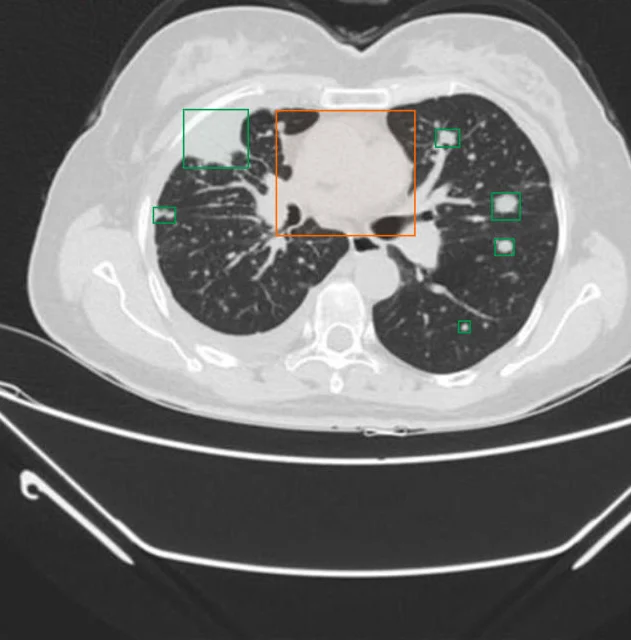
- A pulmonary nodule smaller than 5mm goes unlabeled in a CT training dataset
- The AI model learns to treat such findings as normal or invisible
- In deployment, the model consistently fails to flag early-stage lung cancer
- Patients receive delayed diagnoses and face significantly worse outcomes
This is the stakes of annotation inaccuracy in healthcare AI. Machine learning and deep learning models cannot compensate for flawed training data, no matter how advanced the architecture. The principle holds across every medical AI application: garbage in, garbage out.
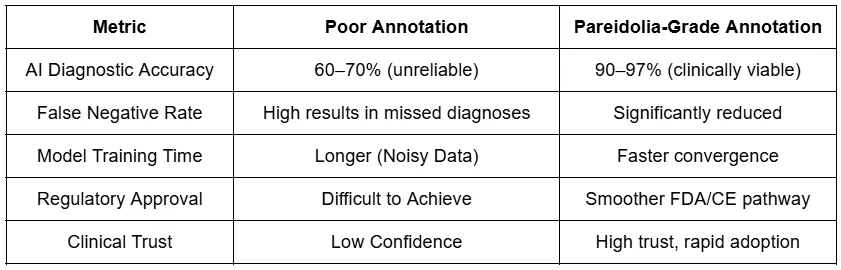
AI models trained on high-quality, clinically validated annotations consistently achieve diagnostic accuracy rates between 90–97%. Those trained on poorly annotated data frequently fall below 70%, well below the threshold for clinical viability. The gap is not algorithmic. It is annotation-driven.
Annotation Quality vs. AI Performance:
Core Annotation Services at Pareidolia Systems LLP
Pareidolia Systems LLP provides a comprehensive suite of medical image annotation services, designed around the specific needs of each AI model and clinical use case. Here is how each service contributes to medical image annotation accuracy:
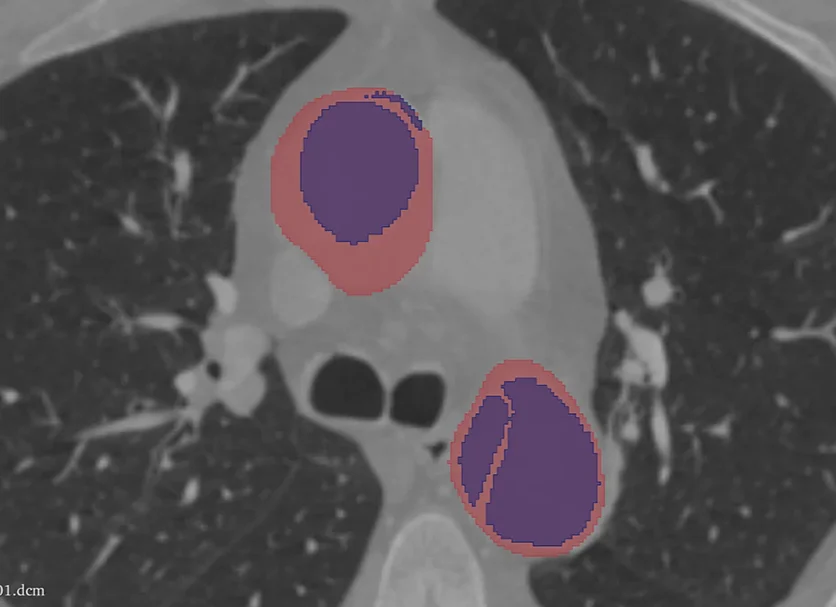
Medical Image Segmentation
Pareidolia’s medical image segmentation service delivers pixel-level boundary delineation across 2D image slices and full 3D volumetric datasets. Our annotators are trained to accurately trace anatomical structures, distinguishing healthy tissue from diseased tissue with the precision that AI model training demands.
2D segmentation use cases include:
- Chest X-ray analysis: pneumonia, pleural effusion, cardiomegaly
- USG segmentation and annotation
- Surgical video annotation
- CT scan & MRI image annotation in neurology, gastroenterology, MSK, cardiology, etc.
3D medical image segmentation performed across CT and MRI scan stacks is significantly more complex, requiring spatial reasoning across axial, coronal, and sagittal planes. Pareidolia’s annotators are trained to maintain anatomical consistency across all slices, preventing the compounding errors that degrade volumetric AI model performance.
3D segmentation applications include:
- Tumor volume measurement for radiotherapy planning.
- Organ delineation for surgical navigation and pre-operative AI.
- Brain structure mapping for neurological AI models.
- Cardiac chamber segmentation for ejection fraction measurement.
- Hemorrhage Volume Measurement.
Annotation of Medical Images
Pareidolia’s medical image annotation service supports a full spectrum of labeling types across multi-modal imaging. Our meticulous annotation workflows, combined with clinical expertise spanning conditions from coronary artery calcification to obstructive hydrocephalus, ensure datasets that are accurate, consistent, and immediately usable for AI training.
What sets Pareidolia’s annotation apart:
- Clinically reliable labels created by medically trained annotators.
- Multi-modality support: X-ray, CT, MRI, ultrasound, digital pathology.
- Disease- and organ-specific labeling with clinical accuracy.
- Complex multi-class annotations handled with clinical logic.
- Consistent labeling standards applied across the entire dataset.
Our medical image annotations empower AI models for diagnostic model development, clinical research datasets, measurement and quantification tasks, and medical imaging quality assessment.
Quality Control in Medical Imaging
Pareidolia Systems’ Quality Control service is a dedicated pipeline that ensures every image and annotation meets enterprise-grade accuracy requirements before it reaches your AI training workflow.
Our QC methodology includes:
- Expert Clinical Team review for the presence/absence of target findings
- Imaging artifact detection and protocol adherence verification
- Multi-level review systems and consensus validation
- Rule-based automated checks and anomaly detection
- Structured QC logs with transparent, case-level decision documentation
- Detection and correction of class imbalance, labeling drift, and reviewer bias
Pareidolia’s QC team understands the subtle visual patterns that differentiate normal anatomical variants from true pathology ensuring that only clinically relevant, clean, and usable imaging data moves forward for AI development.
3D Model Creation
Pareidolia’s 3D Model Creation service transforms annotated imaging data into accurate, anatomically precise three-dimensional models. These models are used in surgical planning, medical education, implant design, and the development of AI tools that require volumetric spatial understanding.
Every 3D model undergoes multi-level validation for anatomical correctness, data consistency, and clinical relevance, ensuring dependable results across medical, educational, and research applications.
Pareidolia’s Cross-Domain Clinical Expertise
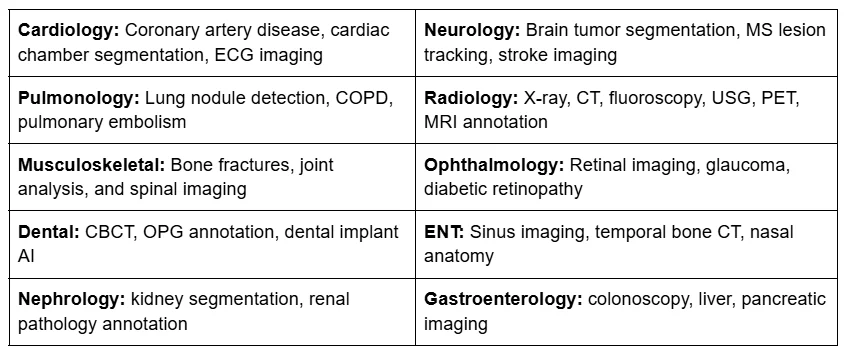
One of the most important differentiators in medical image annotation accuracy is domain expertise. Not all medical images or pathologies are alike. A cardiology annotator cannot apply the same clinical logic to a brain MRI that a neuroradiology-trained annotator would.
Pareidolia Systems LLP maintains deep expertise across ten clinical specialties:
What Makes Pareidolia’s Annotation Clinically High Quality?
Medical image annotation accuracy is not just about drawing lines on images. It requires clinical judgment, domain expertise, and systematic quality assurance at every stage of the workflow. Here is what Pareidolia delivers:
Clinically Trained Annotation Teams
Pareidolia’s annotators are regularly trained and clinically aware, not general-purpose annotators. Our team understands the clinical significance of every boundary they draw, the pathological context of every label they place, and the downstream consequences of annotation imprecision.
Pixel-Level Precision
Medical AI demands sub-pixel accuracy. A segmentation boundary that is even a few pixels off around a tumor margin can distort volume calculations, compromise treatment planning, and mislead AI models. Pareidolia uses specialized annotation tooling to ensure boundary accuracy that meets clinical and research standards.
Multi-Level Quality Review
Pareidolia’s QC operations include multi-stage validation: automated consistency checks, blind reviewer processes, consensus validation, and clinical adjudication of edge cases. Every dataset delivered has passed through structured QC layers with full documentation.
Custom SOP-Driven Workflows
Every Pareidolia project begins with SOP, drafting a detailed Standard Operating Procedure that defines annotation guidelines, inclusion/exclusion criteria, label definitions, and edge case handling. This eliminates subjective interpretation and ensures consistency across every annotator on the team.
Inter-Annotator Agreement Validation
Pareidolia applies inter-annotator agreement (IAA) measurement as a core quality metric tracking consistency between annotators on the same images. Low agreement triggers clinical adjudication, ensuring that only validated, consensus-backed labels become part of the training dataset.
Pareidolia’s Workflow: From Dataset to AI-Ready Data
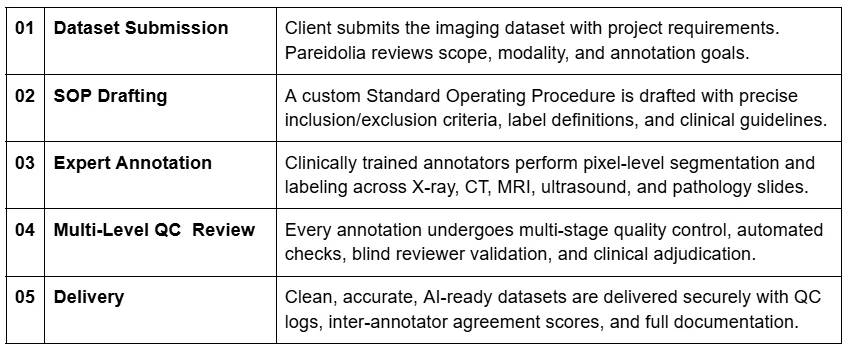
This structured, transparent workflow means clients always know where their dataset stands and can trust that what they receive is clean, consistent, and immediately usable for AI development.
Why Annotation Quality Matters for Regulatory Compliance
Healthcare AI tools, whether targeting FDA clearance in the US, CE Marking in the EU, or UKCA registration in the UK, are evaluated not just on model performance, but on the quality of the training data that built them.
Regulatory reviewers assess:
- Annotation protocols and clinical guideline documentation.
- Annotator qualification and training records.
- Inter-annotator agreement scores and adjudication processes.
- Dataset diversity and class balance.
- QC methodology and anomaly handling procedures.
Pareidolia Systems LLP delivers annotations with full documentation: QC logs, SOP records, and IAA scores, giving AI companies the evidentiary foundation they need for regulatory submission. Poor annotation quality is one of the leading reasons healthcare AI applications face regulatory rejection. We remove that risk.
Why Choose Pareidolia Systems LLP?
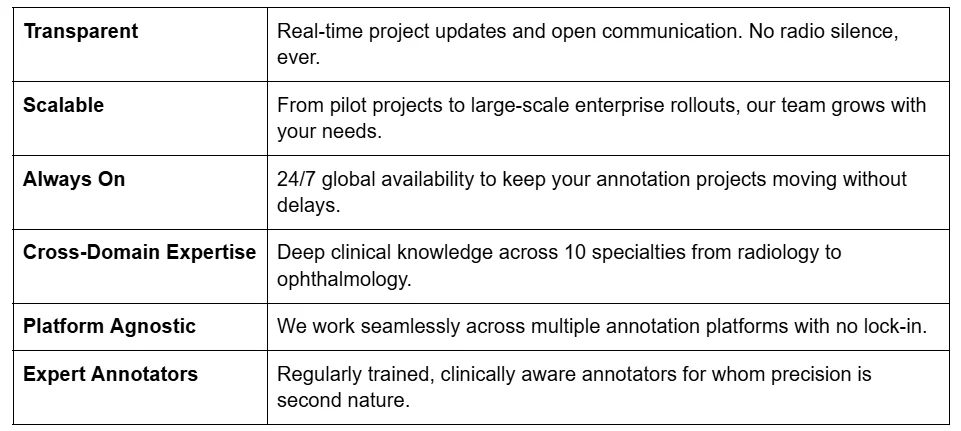
Pareidolia Systems LLP was founded on a single conviction: that the quality of medical image annotation directly determines the quality and safety of healthcare AI. Every service we offer reflects that conviction.
Frequently Asked Questions
Q: What is medical image annotation accuracy?
A: Medical image annotation accuracy refers to how precisely and correctly clinical images are labeled for AI training. It is evaluated through inter-annotator agreement metrics, comparison with clinical ground truth, and QC review, and it is the single most important determinant of AI model diagnostic performance.
Q: What types of medical images does Pareidolia Systems annotate?
A: Pareidolia annotates across all major imaging modalities: X-ray, CT, MRI, ultrasound, and digital pathology slides, across many clinical specialties including cardiology, neurology, radiology, pulmonology, ophthalmology, dental, ENT, musculoskeletal, nephrology, and gastroenterology.
Q: How does Pareidolia ensure annotation quality?
A: Pareidolia uses a multi-level QC pipeline that includes expert clinical review, automated consistency checks, blind reviewer validation, inter-annotator agreement measurement, consensus validation, and structured QC documentation for every project.
Q: What is the difference between 2D and 3D medical image segmentation?
A: 2D segmentation labels individual image slices, while 3D segmentation annotates volumetric datasets across all imaging planes, axial, coronal, and sagittal. 3D segmentation is used for tumor volume measurement, organ delineation, and other applications requiring spatial volumetric understanding.
Q: Does Pareidolia support regulatory compliance documentation?
A: Yes. Pareidolia delivers full project documentation, including SOP records, QC logs, inter-annotator agreement scores, and annotator qualification records, providing the evidentiary foundation required for FDA, CE, and MHRA regulatory submissions.
Q: How does Pareidolia’s workflow begin?
A: Clients submit their imaging dataset, and Pareidolia begins with a requirements review and custom SOP drafting defining annotation guidelines, inclusion/exclusion criteria, and edge case handling before annotation begins. This ensures consistency from the first label to the last.
Precision Annotation. Trusted Results.
Healthcare AI is only as good as the data it learns from, and the data is only as good as the annotation behind it. Medical image annotation accuracy is not an optional quality benchmark; it is the clinical and commercial foundation that determines whether an AI diagnostic tool succeeds or fails.
At Pareidolia Systems LLP, our commitment is simple: every annotation we deliver is clinically informed, quality-validated, and AI-ready. From 2D medical image segmentation to complex 3D MRI annotation, from cardiology to gastroenterology, from pilot datasets to enterprise-scale production, we annotate with the precision that healthcare AI demands.
We Annotate. You Innovate. Pareidolia Systems LLP
Ready to build healthcare AI you can trust?
Partner with Pareidolia Systems LLP for clinical-grade medical image annotation that meets regulatory standards and powers AI models with confidence.
📅 Schedule a Free Demo: calendly.com/pareidoliasystemsllp/30min | 📧 contact@pareidolia.in | 📞 +91 92300 25446